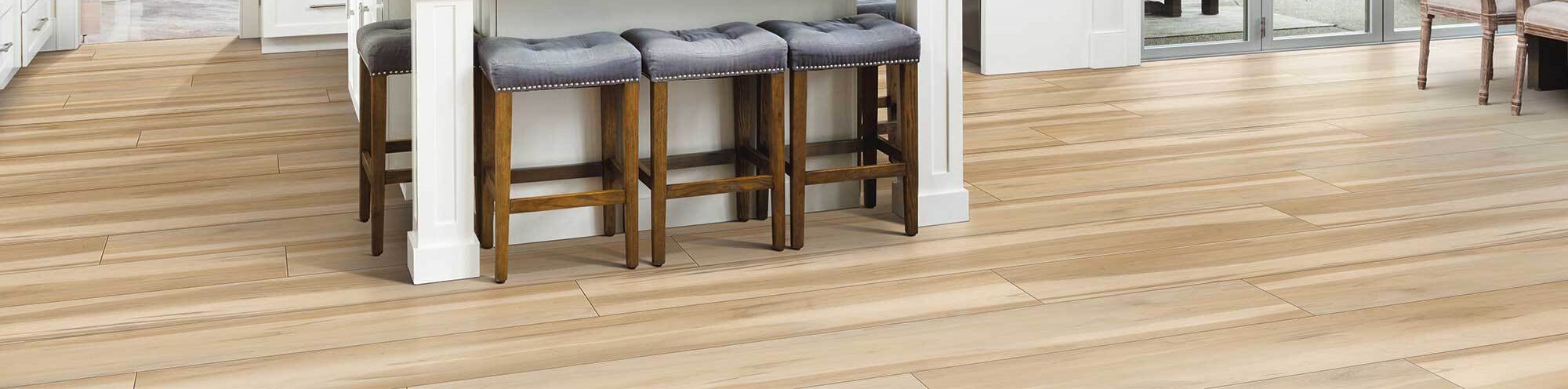
Luxury vinyl plank is durable, attractive, easy to maintain, and available in two primary installation styles: glue-down vinyl plank and locking vinyl plank.
Both can be excellent choices, but the right one depends on your room, subfloor, installation experience, and long-term plans.
Floor Trader Outlet carries both styles in stock at outlet prices. Our flooring experts can help you compare the construction, wear layer, installation requirements, and total project cost before you decide.
Glue-down vinyl plank is installed directly against the prepared subfloor using an approved flooring adhesive. Because the flooring is bonded to the surface below it, it generally has a lower profile and a firm, stable feel underfoot.
Glue-down vinyl plank can be an excellent choice for:
Kitchens, bathrooms and laundry rooms
Small rooms and individual-room updates
Rental properties
Offices and commercial spaces
High-traffic areas
Areas with rolling furniture or equipment
Projects where floor height is a concern
Installation over certain properly prepared existing floors, when approved
Some glue-down vinyl is thinner than locking vinyl, but that does not automatically mean it is lower quality. Thickness, wear layer, construction, finish, warranty, and intended use should all be considered.
Locking vinyl plank uses an interlocking edge system. The planks connect to one another and “float” over the properly prepared subfloor instead of being permanently glued to it.
Many locking products include an attached pad for additional comfort and sound reduction.
Locking vinyl plank can be an excellent choice for:
Living rooms and family rooms
Bedrooms
Basements
Open-concept spaces
Whole-house flooring projects
DIY installations
Projects where faster installation is important
Homeowners who prefer a thicker or more cushioned feel
A floating floor must be able to move naturally. Required expansion space must be maintained around walls, cabinets, fireplaces, pipes, and other fixed objects.
| Consideration | Glue-Down Vinyl Plank | Locking Vinyl Plank |
|---|---|---|
| Installation method | Bonded directly to the subfloor | Planks lock together and float |
| Typical DIY difficulty | Moderate | Beginner to moderate |
| Subfloor preparation | Must be exceptionally smooth and clean | Must be clean, solid, dry and flat |
| Floor height | Usually lower profile | Usually thicker |
| Underfoot feel | Firm and stable | May feel warmer or more cushioned |
| Individual plank repair | Often easier | May require partial disassembly or a special repair method |
| Large commercial areas | Often an excellent choice | Product and space limitations must be checked |
| Small-room updates | Excellent option | Excellent option |
| Whole-house projects | Possible with proper planning | Popular residential option |
| Existing sheet vinyl | Sometimes possible when specifically approved | Frequently possible when specifically approved |
| Adhesive required | Yes | Usually no |
| Expansion space | Product-specific | Required around the perimeter and fixed objects |
Always follow the instructions for the exact flooring, adhesive, and subfloor involved.
Locking vinyl plank is usually the more approachable DIY option. There is no adhesive to spread, and planks can often be cut and connected using common flooring tools.
A successful locking installation still requires:
A properly prepared subfloor
A straight starting row
Correct plank staggering
Expansion space around the room
Accurate cuts around doors and obstacles
Approved transitions when required
Careful handling of the locking edges
A floating floor should not be pinned beneath permanent cabinets or fastened through the flooring unless the manufacturer specifically allows it.
Glue-down flooring can also be DIY-friendly, particularly in a smaller room, but it requires more attention to floor preparation and adhesive application.
The installer may need to manage:
The correct adhesive
Proper trowel size
Adhesive open time
Working time
Plank placement
Adhesive transfer
Rolling requirements
Adhesive cleanup
Once a plank contacts the adhesive, repositioning it may be difficult. Following the flooring and adhesive manufacturers’ instructions is essential.
Neither installation method will fix a poor subfloor. The surface below the flooring must meet the requirements of the selected product.
Because glue-down planks closely follow the surface beneath them, imperfections may eventually become visible through the floor. This is sometimes called “telegraphing.”
The subfloor generally needs to be:
Smooth
Flat
Clean
Dry
Structurally sound
Free of dust, wax, oil, paint and contaminants
Free of loose material and incompatible adhesive residue
Properly patched at cracks, joints and low spots
Concrete may require moisture and pH testing. The results must fall within the limits established by both the flooring and adhesive manufacturers.
A locking floor also requires a flat and stable surface. High spots, low spots, movement or soft areas can cause noise, movement, broken joints, or separation.
The subfloor generally needs to be:
Flat
Clean
Dry
Solid
Structurally sound
Free of movement
Properly patched or leveled
Do not automatically add another foam pad beneath locking vinyl. If the flooring already has an attached pad, additional underlayment may interfere with the locking system or void the warranty. Use only an underlayment approved for the specific product.
In certain situations, yes. Glue-do
wn vinyl plank can be a practical option over properly prepared sheet vinyl, but only when the flooring and adhesive manufacturers specifically approve the installation.
The existing sheet vinyl generally must be:
Embossed patterns, seams and surface texture may need to be covered with an approved patching or embossing-leveling product.
Glue-down LVP should not be installed directly over loose, damaged, heavily cushioned, perimeter-bonded, moisture-damaged, or multiple layers of sheet vinyl unless the product manufacturer expressly approves the condition.
When the existing sheet vinyl is suitable and the new product permits it, installing over it may:
The existing floor must still be carefully inspected and prepared. Installing new flooring over a failed floor does not correct the underlying problem.
Safety note: Older flooring and adhesives may contain asbestos. Do not sand, grind, scrape, cut, or disturb suspected materials until they have been properly evaluated.
Many vinyl plank products are marketed as waterproof, but a waterproof plank does not make the entire room or installation waterproof.
Water can still reach:
Moisture and excessive alkalinity in concrete can interfere with the adhesive bond. Moisture testing and the correct adhesive or moisture-control system may be required.
Glue-down flooring may remain more stable under rolling loads or heavy traffic, but standing water should still be cleaned promptly.
Locking vinyl can be a strong choice for kitchens, bathrooms and basements when the selected product is approved for those locations.
Depending on the product and concrete slab, an approved vapor retarder may be required. Water that travels beneath a floating floor can become trapped, so spills and leaks should be addressed promptly.
Always determine and correct the source of ongoing moisture before installing either type of flooring.
A damaged glue-down plank can often be removed and replaced individually. The old adhesive must be carefully removed or prepared, and the replacement plank must come from the same product and color.
This makes glue-down flooring attractive for rentals, commercial spaces, and other areas where isolated damage may occur.
A damaged locking plank may require the floor to be disassembled from the nearest wall until the damaged plank is reached. Some products permit a cut-in repair, but the procedure must follow the manufacturer’s instructions.
Keeping extra flooring from the original purchase is important with either installation method. Colors and production runs can change, even when a product has the same name.
Glue-down vinyl plank can work especially well for:
It can also be used in large or whole-building installations when the subfloor and flooring system are properly prepared.
Locking vinyl is popular for whole-house and open-concept installations because it can move continuously through multiple rooms and provides a substantial feel underfoot.
However, maximum installation dimensions, transitions, expansion space, cabinets, islands, and fixed objects must be considered. Large continuous installations may require transition moldings depending on the manufacturer.
Glue-down may be the better fit when:
Locking vinyl may be the better fit when:
Bring your measurements, room photos, and information about the existing floor to Floor Trader Outlet. We will help you compare:
With both glue-down and locking vinyl plank in stock, you can compare your options in person and select the flooring that makes sense for your room, schedule, and budget.
Floor Trader Outlet
305 Shoshone Street South
Twin Falls, ID 83301
208-644-3467
Installation requirements vary by manufacturer and product. Always follow the current written instructions for the exact flooring, adhesive, underlayment and subfloor involved.